An Iconic Night: The Grammys That Had Everyone Talking

From “ICE Out” speeches to shocking performances and historic wins, a night that reshaped the Grammys
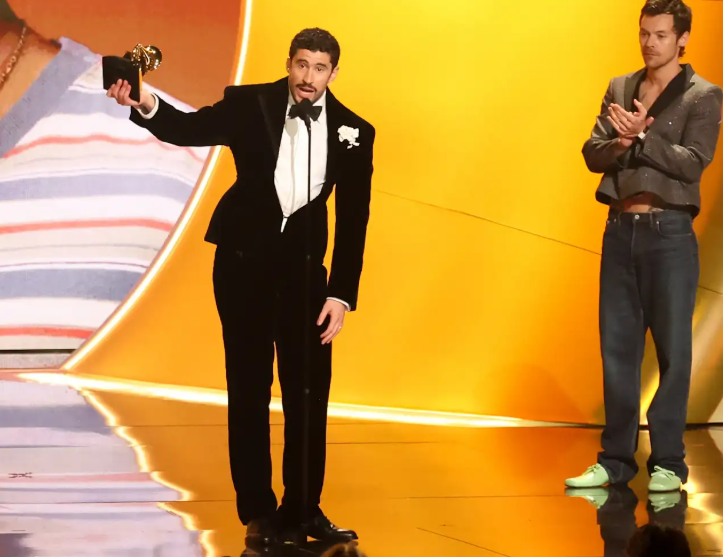
Last Sunday, February 1st, one of the world’s most-watched music award shows, the Grammys, took place at the Crypto.com Arena in Los Angeles, airing live on HBO at 21:30 Brasília local time. The night was packed with unforgettable moments: political statements, sharp jokes about current events, surprise appearances, tributes to late artists, and historical performances. From Cher almost announcing the wrong winner to Justin Bieber's questionable and curious performance, the 68th Grammy ceremony left fans emotional and energized.
One of the most remarkable moments of the night was the “ICE Out” movement, a political protest against the U.S. Immigration and Customs Enforcement (ICE). Billie Eilish, winning Song of the Year — a song released in 2024 but awarded in 2025 — added her voice, saying on stage “No one is illegal on stolen land…we need to keep speaking up, fighting, and protesting. Our voices really do matter, and the people matter.” Bad Bunny also took a stand, saying “Before I say thanks to God, I’m going to say, ICE OUT…We’re not savage, we’re not animals, we’re not aliens. We are human, and we are American.” He added, “The hate gets more powerful with more hate. The only thing that is more powerful than hate is love.” Making history, Bad Bunny became the first Spanish-language artist to win Album of the Year for Debí Tirar Más Fotos, beating Lady Gaga, Kendrick Lamar, and Sabrina Carpenter.
Bad Bunny did not perform at the Grammy due to contractual restrictions tied to his upcoming Super Bowl LX appearance, where he will become the first Latino and Spanish-speaking solo headliner. Speaking about the Super Bowl performance, Trump criticized the choice, saying, “I’m anti-them. I think it’s a terrible choice. All it does is sow hatred. Terrible.” Despite being barred from performing, the singer had a playful moment with the host Trevor Noah. Throughout the night, Noah tried to convince Bad Bunny into breaking his agreement, and eventually the star gave in when Noah started singing the lyrics to “DtMF”. A full band joined them on stage, but Bad Bunny remained focused on respecting his Super Bowl restrictions, joining in just enough to create fun, memorable moments without actually performing.
Trevor Noah hosted his sixth and final Grammy Awards, delivering a sharp mix of humor and commentary. Early in the night, he joked about Nick Minaj’s recent political alignment, saying, “Nicki Minaj is not here…she’s still at the White House with Donald Trump discussing very important issues.” He also poked fun at the Song of the Year, quipping “Song of the Year — that is a Grammy that every artist wants almost as much as Trump wants Greenland, which makes sense because Epstein’s island is gone, he needs a new one to hang out with Bill Clinton.” Noah’s humor ranged from political jabs to playful teases of Kendrick Lamar's drama with Drake, showing why he has been such a nimble and entertaining host throughout his career. He closed the night with the final bow, reminding everyone that even the Grammys must respect term limits: “This is my sixth and last year hosting the Grammys. I’ve loved my time, but I believe in term limits. Leave when your time is up.”
One of the most emotional moments of the night came from Reba McEntire, who made her very first Grammy performance despite having more than 20 years of a legendary music career. At 70 years old, the country icon finally took the Grammy stage, participating in a moving tribute to artists who have passed away. Alongside Brandy Clark and Lukas Nelson, Reba honored several late figures in music, including her stepson Brandon Blackstock, who died after a long battle with cancer. The moment was powerful and symbolic, showing that even after being dedicated to success, Reba continues to make history. Later in the night, Cher made a surprise appearance that instantly became one of the most talked about moments of the ceremony. In a word, she briefly read out “Luther Grandoss”, which may be interpreted as a mixup reference the late Luther Vandross, before quickly connecting herself, and announcing the actual winner, Kendrick, Lamar, and Caesar, for the song” Luther”. The audience laughed, Cher mouthed an apology, and both winners handled the moment with, later defending Cher and embracing the chaos that made the moment unforgettable.
The Grammys also delivered stunning tribute performances that honored music legends lost in recent years. Immediately following Reba McEntire's appearance, she passed the spotlight to Post Malone, Slash, Duff McKagan, Chad Smith, and producer Andrew Watt, who performed a powerful tribute to Ozzy Osbourne, the iconic metal rock artist who passed away last year. Chad Smith's drumming stood out as a beautiful and emotional homage, with Ozzy's family watching from the audience. Later in the night, Lauryn Hill delivered one of the most memorable moments of the ceremony, performing at the Grammys for the first time since 1999. Singing her iconic song “Killing Me Softly”, she honored D’Angelo and Robert Flack, joined by artists such as Wyclef Jean, Chaka Khan, and Jon Batiste. Her unexpected appearance and magic performance turned the tribute into a historic and deeply emotional highlight of the night.
One of the most exciting parts in the night was the Best New Artist performance segment which featured a high-energy medley from all eight nominees, performed in a row. The Marías opened the segment with a gothic rendition of “No One Noticed”, blending English and Spanish lyrics. Addison Rae followed with a pre-taped, high-energy performance of “Fame is a Gun”, filmed in a parking garage with sharp choreography. KATSEYE brought explosive energy with their his “Gnarly”, while Leon Thomes rocked the stage with his funk-driven track “Mutt”. Alex Warren’s performance of “Ordinary” became a standout moment after he experienced severe technical issues with his in-ear monitors, causing timing and sound problems. Despite this, he stayed calm, finished the song, and had the audience singing along, later joking about the mishap online and earning praise for professionalism. Lola Young delivered a haunting piano version of “Messy” with just a piano and a microphone, Olivia Dean — who had won the Grammy for best new artist — charmed the crown with a 1970s inspired performance of “Man I Need”, and SOMBR closed the segment with the whole crowd singing his iconic song “12 to 12”. The seven performances in a row created one of the most memorable and dynamic moments in the ceremony.
The night also delivered shocking moments and historical events that kept the views talking. Justin Bieber made his Grammy return after four years with an unusual and raw performance of his song “Yukon”, taking the stage in boxer shorts with a guitar hanging at his side, leaving the audience stunned. Meanwhile, Kendrick Lamar made Grammy history by surpassing Jay-Z to become the most awarded rapper of all time, reaching 27 Grammy wins. Lamar took home five awards during the ceremony, including Record of the Year for “Luther” with SZA, as well Rap Song and Rap Album, making history in his career.
In the end, the 68th Grammy Awards proved to be much more than just a celebration of music. The night blended powerful political messages, emotional tributes, historic wins, and unexpected moments that will be remembered for years to come. From artists using the stage to speak out, to legends returning and new voices rising, the 2026 Grammys reflected not only the state of the music industry, but also the worlds surrounding it. It was a ceremony that showed how music continues to be a powerful space for expression, connection and change.
Sources:
Comments